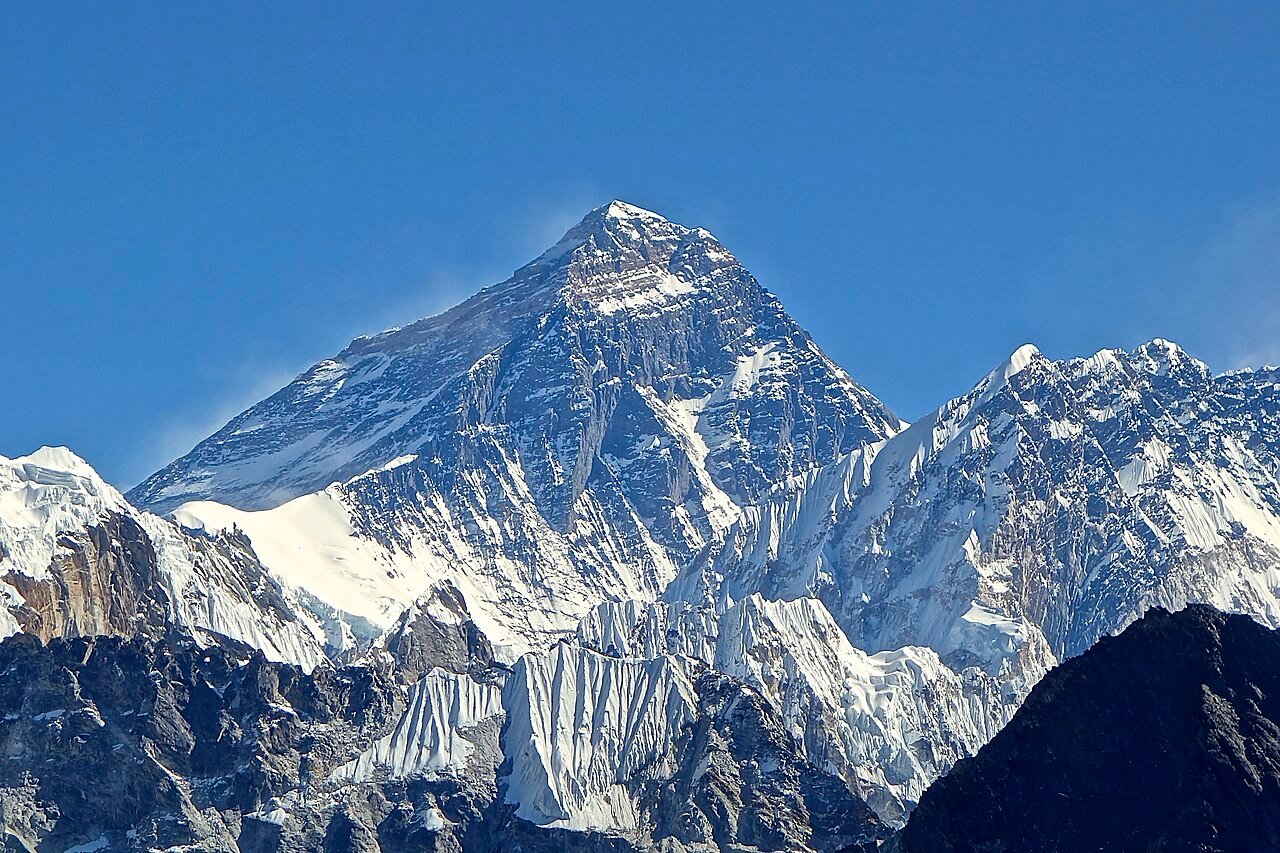
MOUNT EVEREST EXPEDITION

Destination
Everest Region

Duration
60-70 Days Maximum

Grade
Technical Expedition

Max Altitude
8,848.86 m

Group Size
2-12 Pax

Meal
All Inclusive

Activity
5-6 hrs, 10-12 hrs (summit day)

Accommodation
Lodge / Camping

Season
Spring
Description
Mount Everest – the World’s Highest Peak and the Most Sought After Expedition in the World
The Mount Everest Expedition is one of the most formidable and iconic challenges, combining extreme altitude, profound physical and mental endurance and intricate logistics. South Col Route , the popular and historically significant route, first climbed by Sir Edmund Hillary and Tenzing Norgay in 1953, involves trekking through the Khumbu Valley, passing the bustling hub of Namche Bazaar, and acclimatizing at the Everest Base Camp at 5,364m.
Is Mount Everest an Expedition for Everyone?
Absolutely not. These are the Key Challenges and Dangers to be considered:
Altitude Sickness (AMS, HACE, HAPE): The primary threat. Fluid can build up in the lungs or brain, which can be fatal without immediate descent.
Extreme Weather: Hurricane-force winds, blinding snowstorms, and temperatures dipping below -40°C/F.
The Death Zone: Above 8,000m, oxygen levels are insufficient to sustain human life for long. Cognitive and physical functions deteriorate rapidly.
Technical Terrain: The Khumbu Icefall (a shifting maze of giant seracs and crevasses), steep icy rock faces, and exposed ridges like the Hillary Step.
Traffic Jams: On popular days, bottlenecks on the route (like below the Hillary Step) can force climbers to wait for hours in the Death Zone, depleting oxygen and increasing risk.
Frostbite & Exhaustion: Constant threats due to the cold and physical demands.
When to Climb?
Climbing Mount Everest is typically done during the spring months of April to May, which are the months that offer the most stable weather conditions.
The Essence of the Experience
Beyond the physical summit, an Everest expedition is a profound human journey. It involves:
Mental Fortitude: Coping with fear, discomfort, isolation, and uncertainty.
- Cultural Immersion: Interaction with the resilient Sherpa people and their rich culture.
- Teamwork & Trust: Absolute reliance on guides, Sherpas, and fellow climbers for survival.
- Awe & Humility: Being in the presence of the planet’s most majestic and unforgiving landscapes.
In summary, a Mount Everest expedition is a monumental undertaking that tests the absolute limits of human capability. It is a complex blend of high-altitude mountaineering, sophisticated logistics, profound personal challenge, and deep respect for the mountain’s power and the culture that surrounds it. Success is not guaranteed, and the mountain demands the highest levels of preparation, respect, and humility.
Itinerary
Arrive in Kathmandu, where you’ll be greeted and assisted to your accommodation. Take the day to rest and prepare for your upcoming journey.
Office Meeting and briefing, introduction to the Climbing Guide, conduct essential briefing and checks on climbing, session to check and go through the use of essential gears/equipment, Getting ready for the expedition
Leaving Kathmandu early in the morning, we will fly to Lukla (from Kathmandu or Ramechhap), where our crew will share our loads. We will have our breakfast in Lukla town while we admire the breathtaking view of Mount Kongde Ri (6187 m).
After breakfast, we begin our Everest expedition hike along the Dudh Koshi River through the colorful street of Lukla. We will obtain the Sagarmatha National Park permit and Khumbu Pasang Lhamu Rural Municipality permit in the last village of Lukla. The trail leading us to Phakding is relatively easy during which we will descend most of the time.
After having our permits checked, we will hike past the villages of Chheplung, Chaurikharka, and Thadokoshi. We will stop for a while at Thadokoshi to enjoy the view of Mount Kusum Kangaru (6367m).
A downhill walk forward will take us to Ghat. Along the trail, a remarkable view of Mount Khumbila (5761 m) will accompany us. We arrive at Phakding where we will rest for the night.
Note: In spring and autumn, a direct flight from Kathmandu to Lukla may not be possible due to high volume of air traffic. In the event there are no direct flights, we will travel by private jeep to Ramechhap airport in 4 hours, and from there, we will take a 20-minute flight to Lukla.
.
After having breakfast the trekking will start with crossing of suspension bridges and experiencing stunning vistas en route to Namche Bazaar, a bustling Sherpa town. From Phakding to Namche Bazaar, it is a captivating journey through the heart of the Khumbu region Nepal.
Starting in Phakding, the trail follows the Dudh Kosi River, crossing suspension bridges adorned with prayer flags. The path meanders through lush forests filled with rhododendron and pine trees, offering glimpses of the towering peaks.
As you ascend, you’ll encounter charming Sherpa villages like Monjo and Jorsalle, providing insights into the local way of life. The Sagarmatha National Park checkpoint marks the entry to this UNESCO World Heritage site, showcasing the rich biodiversity of the region In Nepal and highlight of the trek is the challenging climb to Namche Bazaar, a vibrant Sherpa town nestled in a natural amphitheater. The steep ascent is rewarded with stunning views of Thamserku and Kusuk Khangkaru peaks. Namche Bazaar itself is a bustling hub with teahouses, shops, and a vibrant market. Take time to acclimate, explore the town, and savor the breathtaking panorama of Everest and surrounding peaks. The path meanders through lush forests filled with rhododendron and pine trees, offering glimpses of the towering peaks. and will encounter charming Sherpa villages like Monjo and Jorsalle, providing insights into the local way of life.
Today is Acclimatization Day,
We hike to an elevation of 3,880m where Hotel Everest View is located. Everest View Hotel is the highest altitude luxurious Hotel in the world, from there you can see awesome views of Mt. Everest, Lhotse, Nuptse, Cholatse and Ama Dablam. During the hike, you can see syangboche airport and sagarmatha where waste from the Himalayas is being recycle. We will enjoy our morning with tea or coffee in the hotel balcony with the panoramic backdrop of Everest andits neighboring peaks.
Then, we will descend to Namche, explore its local markets, and learn about the unique culture and traditions of the Sherpas.
Journey through rhododendron forests and small hamlets on your way to Phortse Village, a serene village offering remarkable mountain vistas
We will trek along the Dudh Koshi River along as easy path to reach Sanasa. Tackling the steep climb for about an hour and forty minutes, we will arrive at Mongla Danda (3973 m). The magical views of Cholatse, Taboche and the entire Khumjung village will greet us at the top of Mongla Danda. This is where we will stop for a lunch break.
Post lunch, we will trek down for approximately 35 minutes to reach Phortse Thanga. We will now cross the wide Dudh Koshi River over a suspension bridge and climb for about two hours to arrive at Phortse village where we will retire for the night.
Trek from Phortse to Dingboche takes you through a series of charming villages, each offering unique cultural experiences. Starting in Phortse, a traditional Sherpa village, you’ll pass through Pangboche, known for its ancient monastery and scenic views. Continuing on, you’ll encounter Somare, a small settlement, before reaching Dingboche. The trail winds through diverse landscapes, including lush forests, open plains, and high-altitude terrain. Expect breathtaking views of iconic peaks like Ama Dablam and Taboche. Villages along the way provide opportunities to interact with locals and witness their daily life. As you trek, pay attention to altitude and acclimatize appropriately. The journey is not only about reaching Dingboche but also about immersing yourself in the rich cultural and natural tapestry of the Everest region.
After having breakfast your hiking to Nagarjung will start. Dingboche to Nagarjung View Point offers a breathtaking trekking experience in the heart of the Himalayas. As you ascend from Dingboche, you’ll be surrounded by stunning landscapes, including towering peaks and picturesque valleys. The trail takes you through diverse terrain, from alpine meadows to rocky paths, providing a mix of challenges and rewards.
Nagarjung View Point, situated at a higher elevation, promises panoramic vistas of the surrounding peaks, including Ama Dablam, Lhotse, and Everest. The journey involves navigating through Sherpa villages, where you can experience the local culture and hospitality. Don’t forget to acclimatize properly to the altitude as you gain elevation, ensuring a safe and enjoyable trekking experience
Leaving Dingboche, we hike forward along a stony path and tall bushes to reach Dughla. Here we will take a lunch break.
Then, we climb steeply to the top of Thukla La Pass at 4830 m. On its small plateau, there are some stones piled up decorated with prayer flags. This site is dedicated to the brave Sherpas and climbers who lost their lives when embarking on a daring adventure in the Khumbu region.
After offering our prayers, we will enjoy the beautiful mountain panorama this Pass offers with the scenery of Ama Dablam, Lobuche, and Lobuche Peak Base Camp.
Finally, crossing vast pastures, green forests, and rows of trees, we will reach Lobuche. In the final stages of the trek, you cross glacial moraines and steep climbs.
In the early morning, after breakfast, we will head to the Everest Base Camp. We will walk through narrow tracks and long terraces with a constant view of Changri Glacier, Nuptse, and Pumo Ri. We will arrive at Gorakshep shortly, where we will rest for lunch. This town is the last village leading us to Everest Base Camp with some lodges.
Here we will leave our luggage and head towards Khumbu Glacier. Crossing several rivers and snow-covered terraces, we will climb steeply to the top of the ridge, which opens the way to Everest Base Camp. Once at the base camp, we can admire panoramic views of the Khumbu region, Nuptse, Lhotse, Khumbutse, and Pumori including the icefall and the glacier.
Before setting off to climb Everest, we must be mentally and physically prepared, so that we can overcome obstacles that we may encounter in the coming days. The preparation stage will help us acclimatize to the altitude as well.
During this period, we will learn and familiarize with the very important climbing skills of using oxygen cylinders, radios, ice axes, jumars, crampons, climbing ladders, and ascending and descending the ropes.
After the preparation stage, we will then set off towards Camp I (6,065 m) along a route that has already been previously established with ropes and ladders through the Khumbu icefall. This camp is located on the top of the Khumbu Icefall with endless snow, deep crevasses, and mountain walls. It is primarily used to drop off equipment and stay in case of emergency.
We will then head to Camp II (6,400 m), where we will spend several days for acclimatization. It is located at the foot of the frozen Mount Lhotse. Here, we will make full use of the climbing equipment, including crampons, ice axes, ropes, and more.
Next, we ascend to Camp III (7,163 m), which is adjacent to the Lhotse wall. We will stay here again for several days to practice using the climbing equipment.
The next stage will take us to Camp IV (7,950 m) after climbing 1219.2 m of the Lhotse wall using fixed ropes. We may have to use oxygen for the climb.
Now, the real ascent to Everest begins. From Camp IV, the summit is about 500 meters away. This is the last and most dangerous part of the climb. The wind here can be violent enough to destroy tents. After conquering this last 500m, we will finally reach the summit of Everest, the journey is expected to take about 10 to 12 hours.
Once we reach the top, we will have a 360-degree view of the Everest region from the summit. After basking in the joy of a successful ascent, we will return to base camp.
Important Note:
The activities and program we have detailed here may not be as described and planned. Several factors can change our program including climate condition, weather, our health status, and our readiness to proceed. For example, at the occurrence of adverse conditions, we may have to return to Camp I after progressing to Camp II and Camp III.
Enjoy your breakfast with Khumbu snow and ice at the Everest Base Camp. After a historic completion of climbing Everest, we will fully enjoy our morning today.
Then, we will clean up our place at the base camp. As a part of our eco-friendly and sustainable tourism motto, we believe in building the Everest Sustainable Base Camp. We will collect the waste and garbage and dump them when we hike back to Lobuche. Here, the Sagarmatha Pollution Control Committee (SPCC) has established rubbish pits to collect waste.
After this, we will pack our bags in the evening and prepare to trek back to Lukla.
Leaving Base Camp, we will follow the same trail and descend towards Gorakshep and Lobuche. Enjoy the remarkable views of Kalapatthar and Lobuche Peaks. Then, crossing the Dughla Pass, we will arrive in Thukla. Crossing several forests and narrow paths, we will be at Pangboche, where we will spend the night.
After breakfast, we descend towards Tengboche, Phunki Tenga, and reach Namche Bazaar, following the course of Imja Khola and Dudh Koshi river. Discover the wildlife, natural diversity, ancient culture, and tradition of the Sherpa people and enjoy breathtaking views of various snow-capped peaks, including Mount Everest, along the route.
From Namche, we will descend to Monjo Village and then Phakding. We will now walk towards Lukla along the Dudh Koshi River, crossing several hanging bridges and beautiful waterfalls.
After bidding farewell to the Himalayas, we will take a flight to Kathmandu. Once in Kathmandu, you can spend a well-deserved and restful day in Thamel, Kathmandu.
In the evening, we will celebrate our accomplishment with a Nepali cultural meal in one of the finest restaurants in the city.
Depart for the international airport, concluding your incredible journey in Nepal.
Cost Includes
- Airport pick up / drop transfer to hotel
- 3 night accommodation in a 3* star hotel with breakfast included
- All Ground transportation
- All domestic airline tickets Kathmandu - Lukla - Kathmandu and All government taxes.
- Everest Expedition Climbing Permits and Entrance Fees.
- All necessary Accommodation during the trek / teahouse/ lodge.
- All necessary oxy meter to check up pulse.Oxyegen Level
- All Meals Breakfast, Lunch, Dinner with tea choose From The Menu System Daily
- All Necessary Base Camp Set, Unlimited Foods, Tea/ Coffee, Hot Water in The Base Camp
- C1, C2, C3, C4 All High Foods, Tea/ Coffee Ready-made System, Boiled Water,
- All necessary Tents, Matrix In The Base Camp
- Guide and helper salary, foods, drinks, accommodation
- All staffs (Guide And Helper Transportation and Insurance.
- Experienced , license holder climbing guide.
- Strong Sherpa Helper( 1 Porter For 2 Trekkers)
- Fresh fruits daily after dinner During The Trek
Cost Exclude
- Nepal entry visa fees- but visa is obtained in tribhuwan international airport Kathmandu
- International flight tickets
- personal medical and Travel insurance.
- personal expenses like bar bill, laundry, drinks, foods, during the trekking
- Mobile, camera battery, power bank charging, wifi, shower etc
- Additional foods, drinks, extra day more accommodation, and expenses in case early return from the mountain or trek
- personal rescue if needed
- Personal rescue expenses in case of need are not part of the package and would be additional if required.
- Tips for staff (guide and porter)
- After Successfully Summit Everest Bonus For Climbing Guide Minimum 1200 USD Each Climber
Essential Gear Checklist
Clothing:
- Comfortable Daypack with a waterproof bag cover
- Comfortable Trekking Boots
- Comfortable Sports/Light Shoes
- Several pairs of comfortable T-shirts
- Sandals
- 3-4 pairs of normal and warm socks
- Comfortable Trekking Pants
- Thin layers for comfort
- Warm layers for insulation
- Waterproof jacket and pants for comfort
- Warm hat and sun cap
- Thin and warm gloves
- Sunscreen
- Sunglasses
Gear Provided (to be returned after the trip):
- Warm sleeping bag
- Warm Down Jacket
- Trekking poles for support
- Trekking Duffel Bag
- Water bottle for hydration
- Water purification tablets
Personal Climbing Gears
- Warm sleeping bag
- Light And Comfortable Matrix For C1, C2, C3, C4
- Full Down Set
- Climbing Sunglasses 100% UV Protected
- Summit Gloves
- Summit Socks
- Goggles Glasses
- Full Set Harness Like, Ascender, Descender Device, 3 Lock Carabiners, 2 Onlock Carabiners, Tape Sealings or 2.5 Safety rope
- Ice-Axe
- Thermos Flask for hot water
- Climbing Bag
- Water bottle for hydration
- Water purification tablets
Gallery